
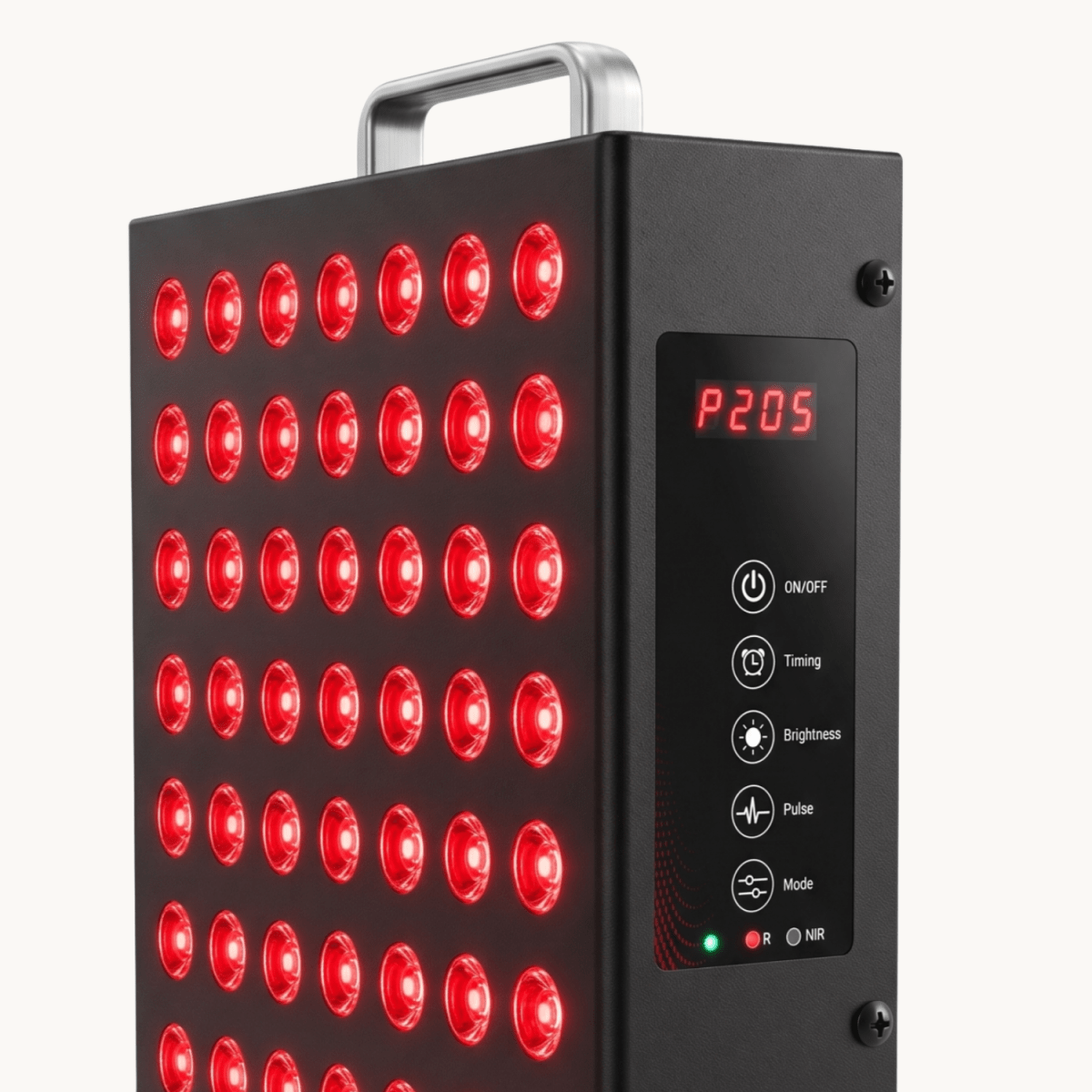
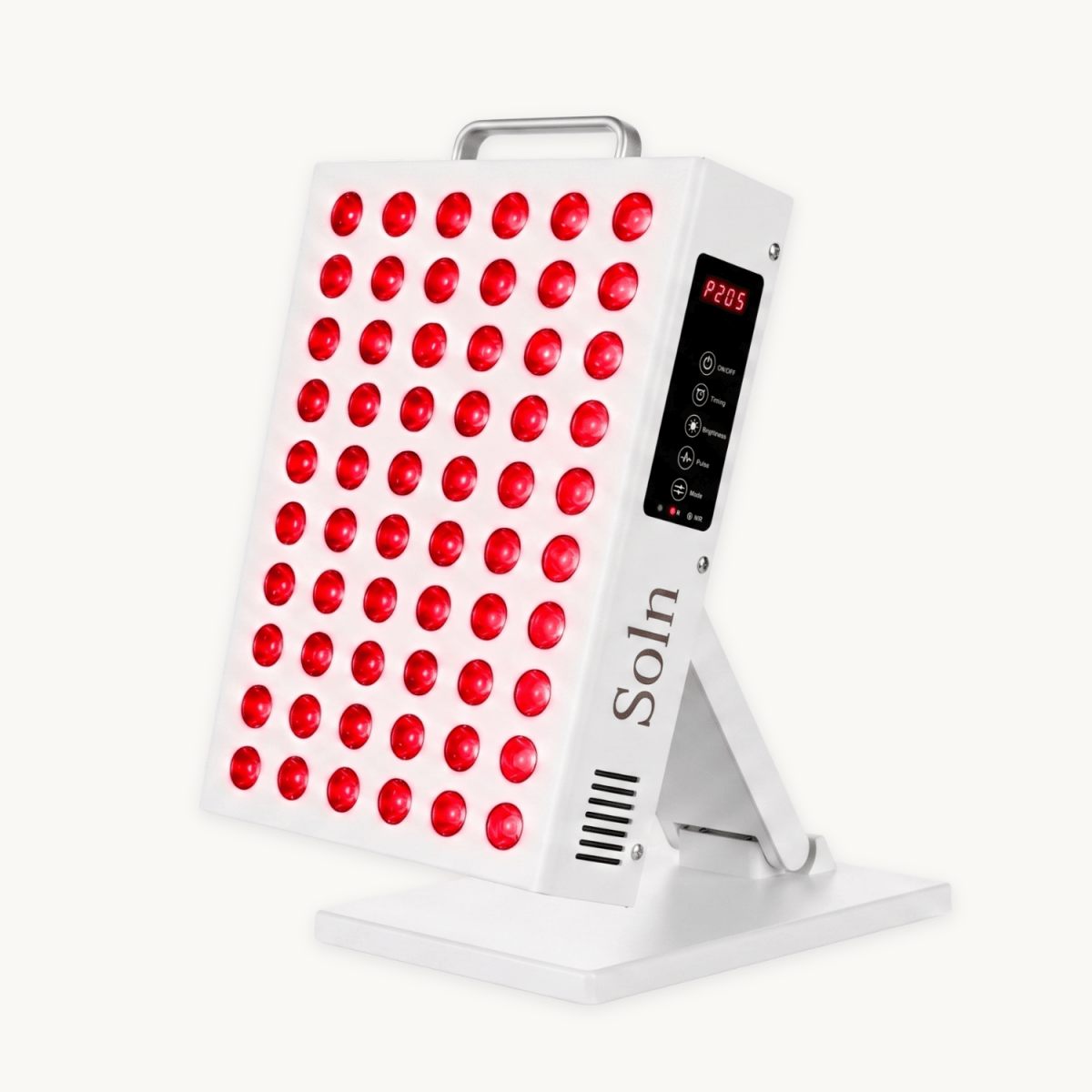
Red Light Therapy Panel
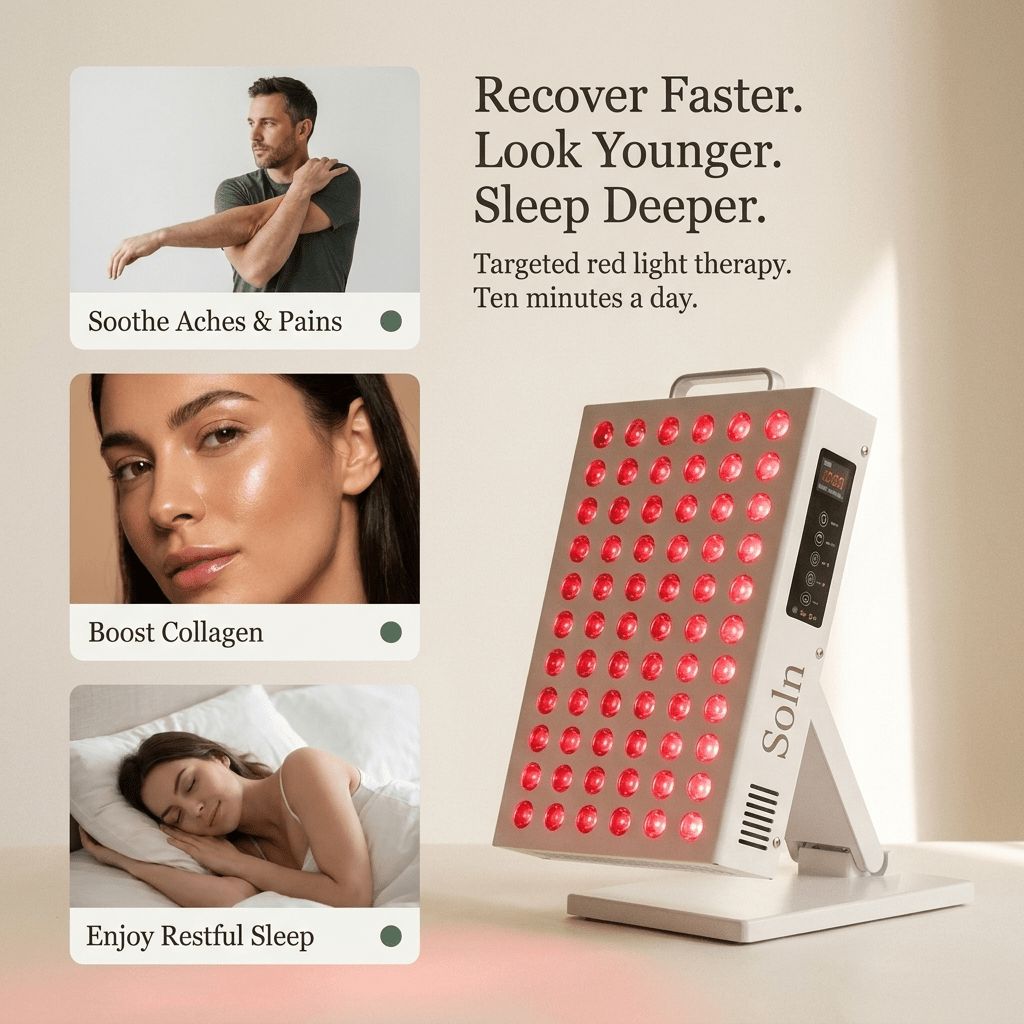
Soothe a sore back or knee, right where it nags
Stronger than a face mask, for smoother, firmer skin
Wind down into deeper, easier sleep
Ten minutes a day, easy to keep up
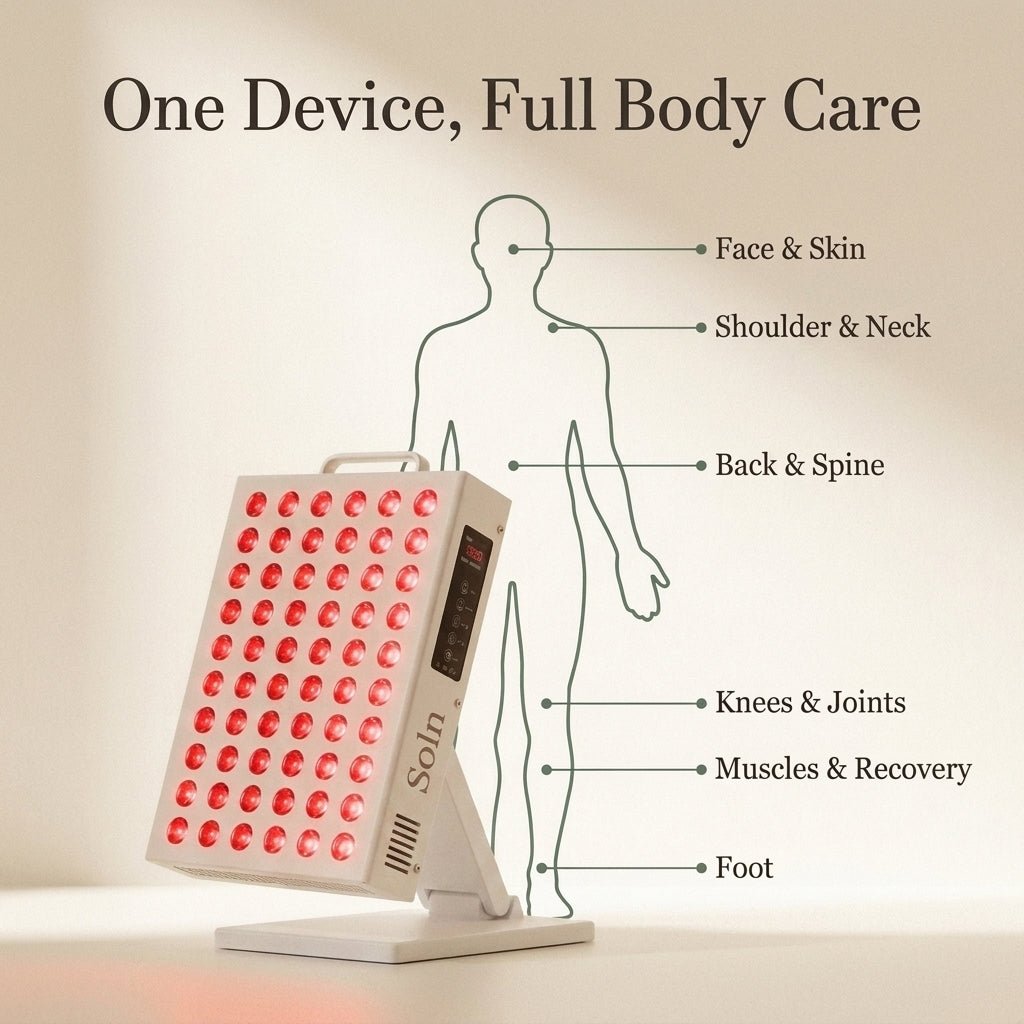
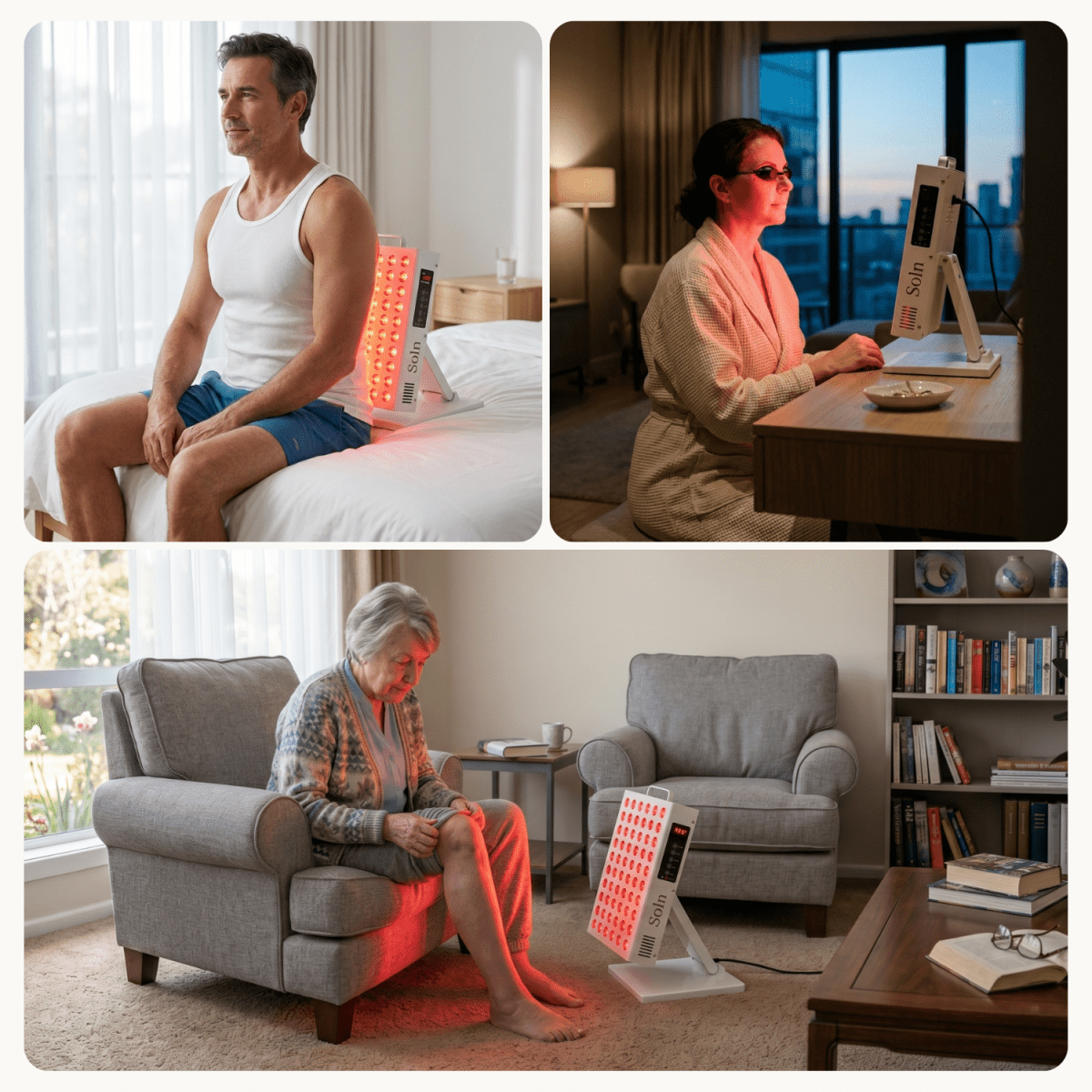
One panel the whole family reaches for
Arrives damaged? We send a replacement, free.
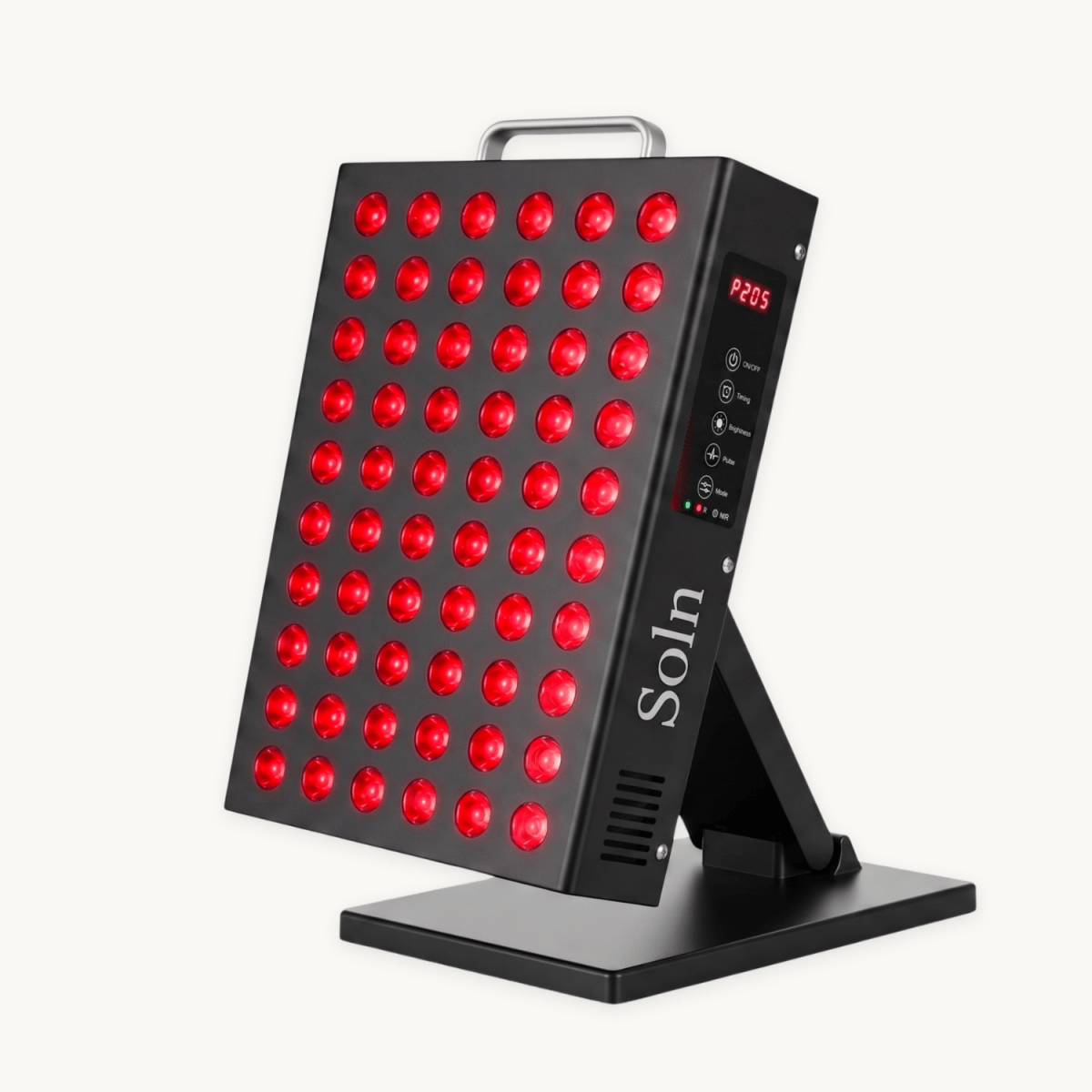
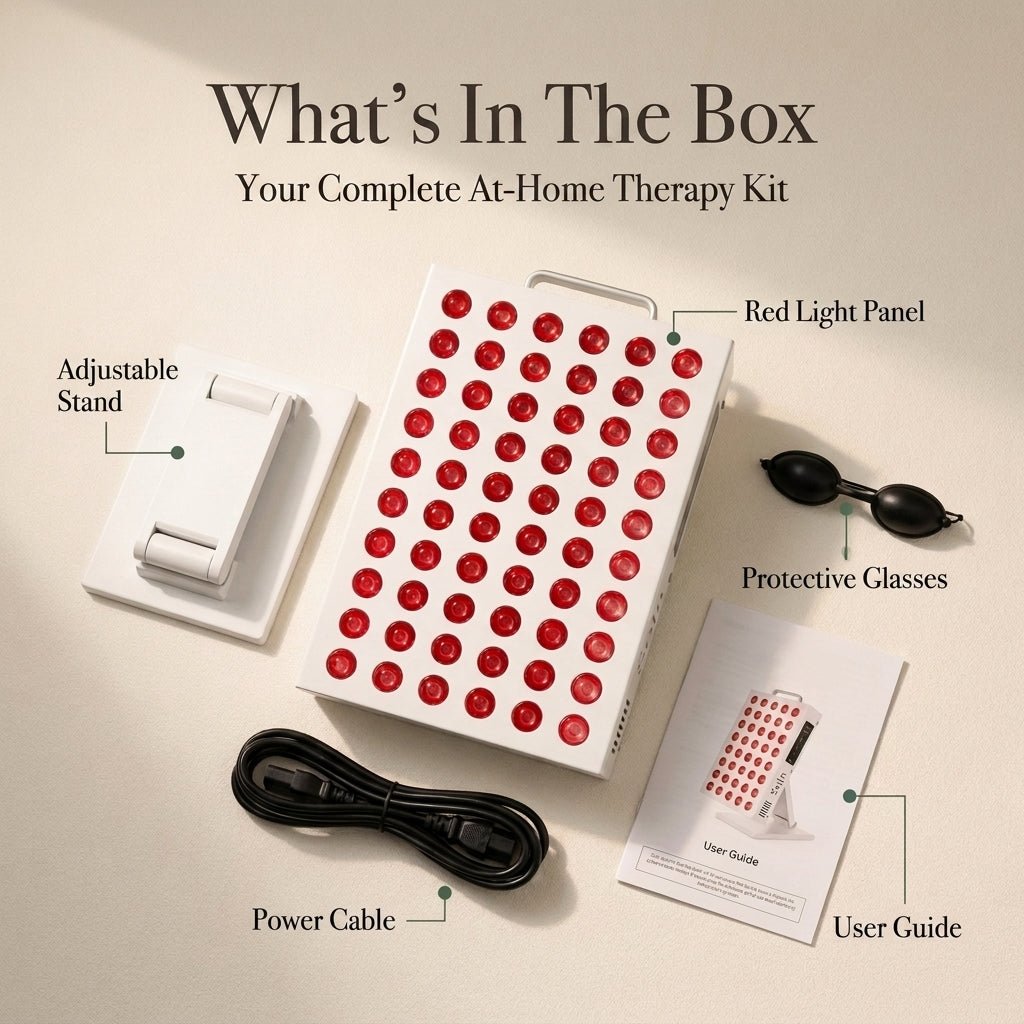
Red Light Therapy Panel
31 × 23 cm (12.3 × 9 in).
Tabletop kickstand
Included.
Protective goggles
Included. Near-infrared light is invisible to the eye. Eye protection is not optional.
Power cable
Plug type matched to your delivery address.
User manual
Treatment protocols, distances, timing guidance.
- Wavelengths: 660nm red and 850nm near-infrared
- LEDs: 60 dual-chip LEDs at 5W each, every LED carrying both wavelengths
- Total power: 300W
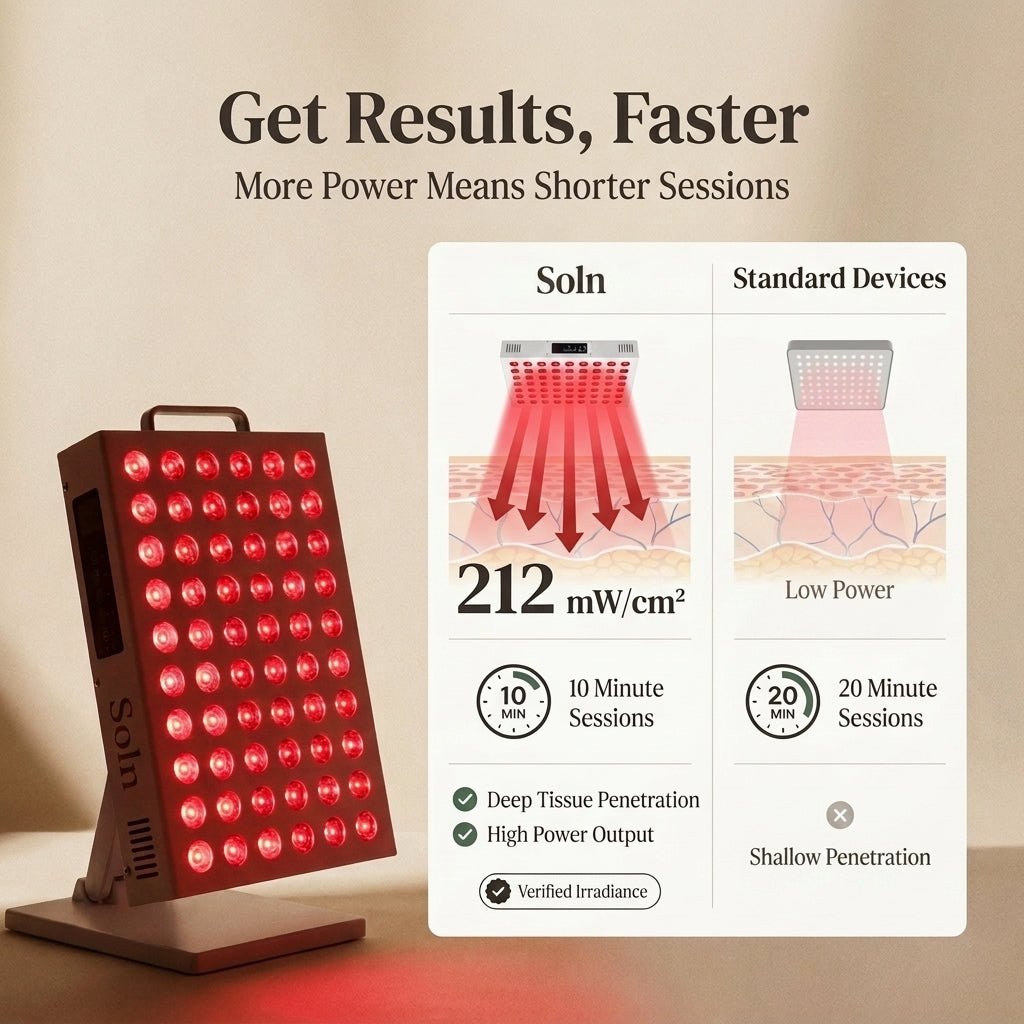
- Peak irradiance: 212 mW/cm² at 3 in (8 cm)
- Pulse: 0, 10, 20, 30 Hz
- Brightness: 20 to 100%, in five steps
- Modes: red only, near-infrared only, combined
- Panel size: 31 × 23 × 6.6 cm (12.3 × 9 × 2.6 in)
- Weight: 3.34 kg (7.4 lb)
- Certifications: CE, MDR, RoHS, FDA 21 CFR 177
- Warranty: 2 years
Shipping: We offer free shipping on all orders. Most orders arrive within 6-11 business days. For full details, see our shipping policy.
Returns: Items can be returned within 60 days of delivery if unused and in original condition. For more information, please visit our refund policy.
Warranty: 2 years. If it fails within the first two years, email us at studio@discoversoln.com and we will sort it.
Skin, recovery, and sleep. One ten-minute session.
Skin that looks like it got some rest.
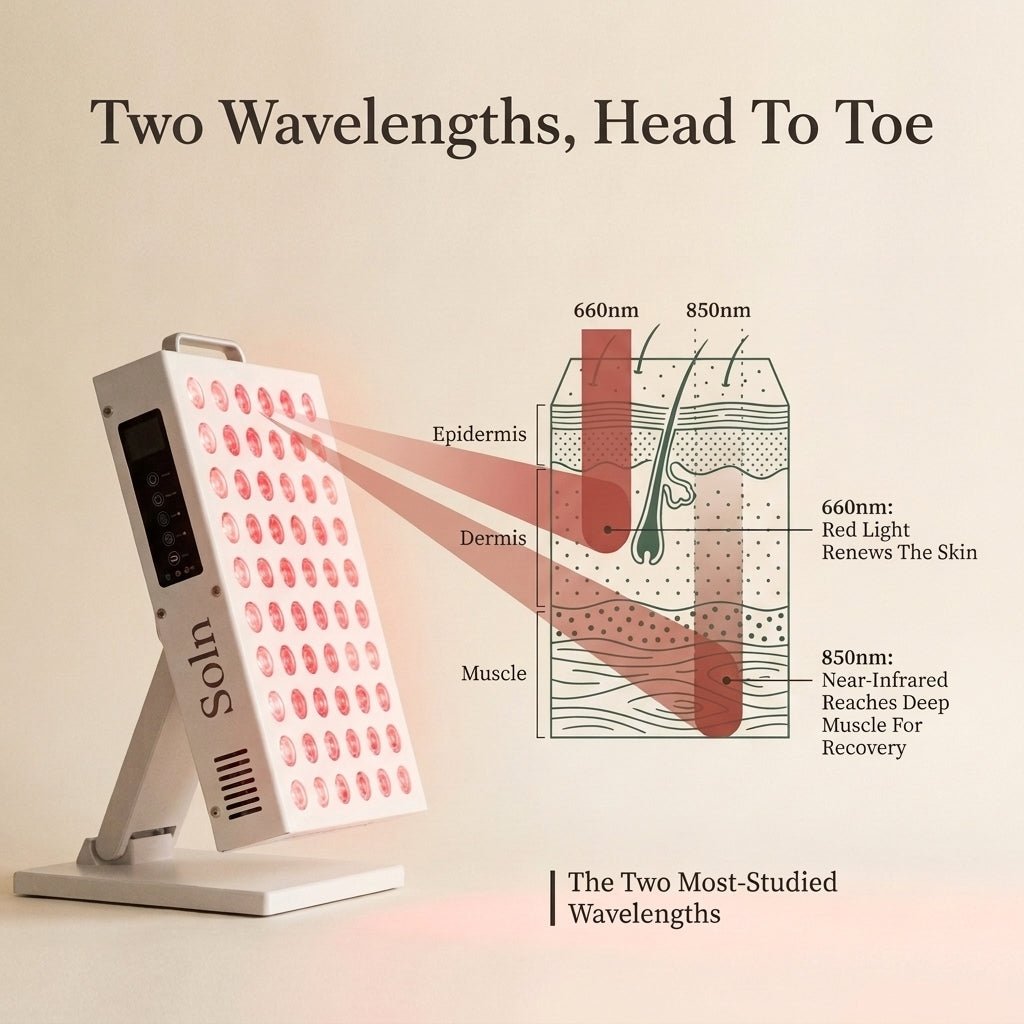
660nm red light penetrates the upper dermis to stimulate collagen production, support skin's natural renewal process, and even skin tone. Fine lines soften. Redness calms. Skin tone evens out.
The kind of glow that used to require a clinic visit and a long weekend to recover from.
The deep recovery your body has been asking for.
850nm near-infrared light reaches where surface treatments cannot: into muscle, joint, and tendon tissue, supporting the body's natural recovery response, deep in muscle and joint tissue.
For the lower back that never fully released. The knee that complains on stairs. The shoulder tight since the last time you carried too much.
The wind-down your body has been waiting for.
Near-infrared light supports the body’s natural wind-down in the evening. Many people describe an easier transition into rest.
Ten minutes before bed. The kind of reset that a screen, a supplement, or a second glass of wine never quite managed.
What the science has measured
Findings from light-therapy studies. Tap a ring for the source.
Increase in skin collagen density with consistent red light exposure
See the study →Of participants reported reduced tension and discomfort in photobiomodulation studies
See the study →Improvement in sleep quality with near-infrared exposure
See the study →Faster post-exercise recovery reported in PBM meta-analysis
See the study →▸ View clinical references
1 Wunsch A, Matuschka K. A controlled trial to determine the efficacy of red and near-infrared light treatment in patient satisfaction, reduction of fine lines, wrinkles, skin roughness, and intradermal collagen density increase. Photomed Laser Surg. 2014;32(2):93–100.
2 Chow RT, Johnson MI, Lopes-Martins RA, Bjordal JM. Efficacy of low-level laser therapy in the management of neck pain: a systematic review and meta-analysis. Lancet. 2009;374(9705):1897–1908.
3 Zhao J, Tian Y, Nie J, Xu J, Liu D. Red light and the sleep quality and endurance performance of Chinese female basketball players. J Athl Train. 2012;47(6):673–678.
4 Leal-Junior EC, Vanin AA, Miranda EF, de Carvalho PT, Dal Corso S, Bjordal JM. Effect of phototherapy (low-level laser therapy and light-emitting diode therapy) on exercise performance and markers of exercise recovery: a systematic review with meta-analysis. Lasers Med Sci. 2015;30(4):925–939.
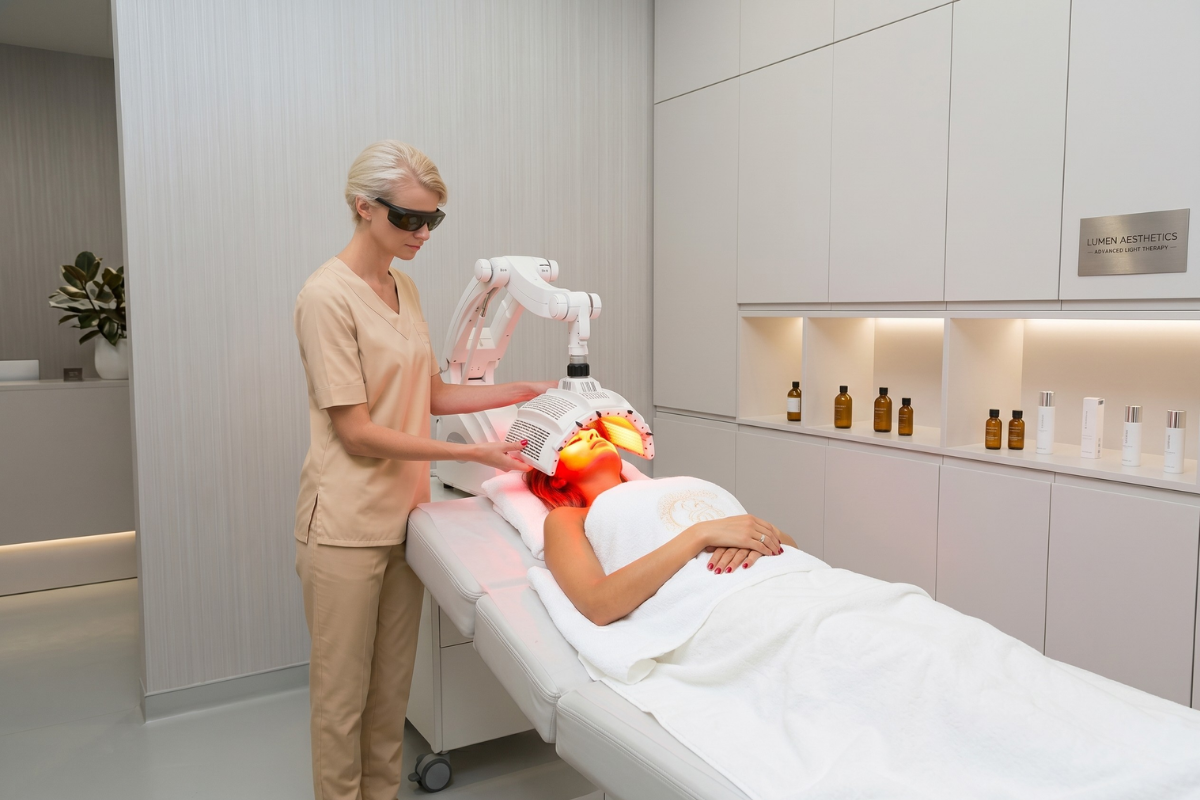
The clinic wavelengths. Without the clinic schedule.
Booking the appointment. Getting there. The waiting room. The paper towel on the treatment table. The fluorescent lights. Paying for the session, every time. Then doing it all again next week.
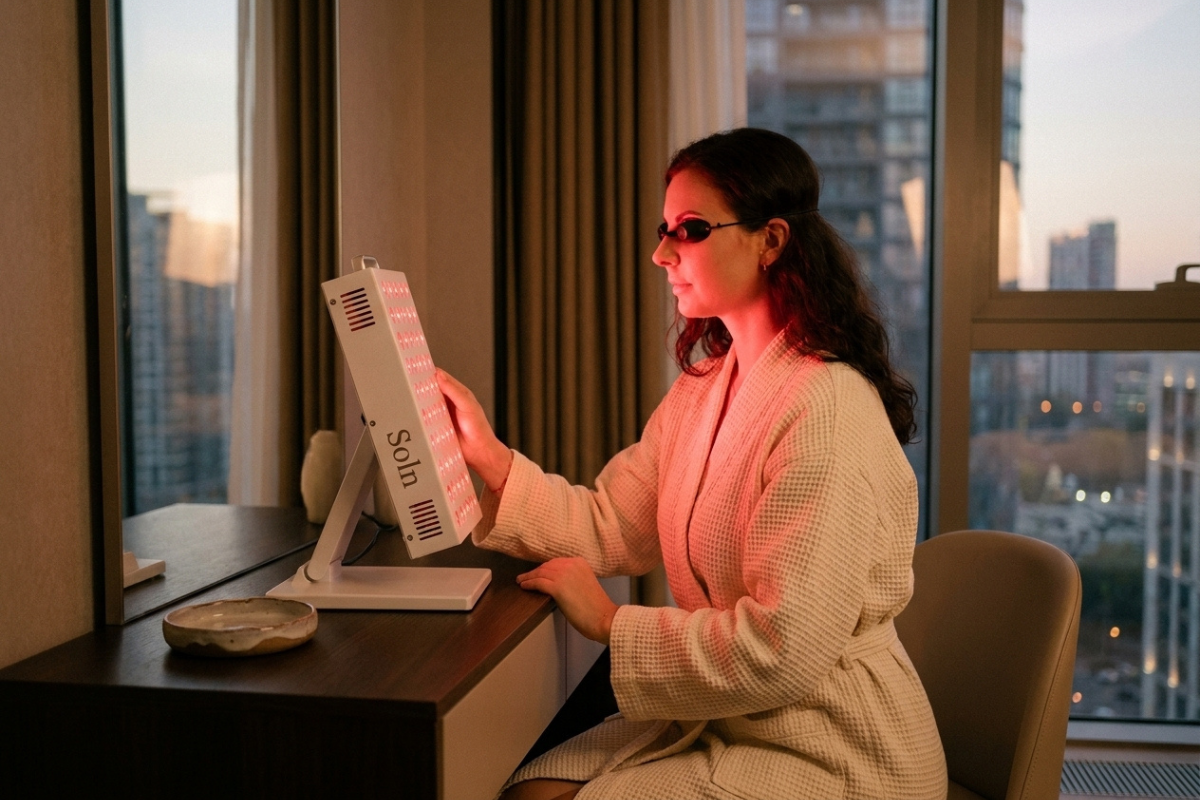
The Soln Compact Panel delivers the same 660nm red and 850nm near-infrared wavelengths, from your bathroom counter, your bedside table, or your sofa. No booking. No commute. No paper towel.
Before
After
The clinic charges by the session. You pay once.
One session: $75–$150. Weekly visits add up to thousands a year. Plus the commute, the booking, and the waiting room.
Under $0.30 per session. No appointment. No waiting room. No one asking you to fill in a form.
What clinicians tell us.
Clinician note
The 660nm wavelength has the strongest published evidence base in skin photobiomodulation, particularly for collagen synthesis and surface redness. I tell patients to think in weeks, not days. Most see texture changes around week six to eight with near daily use, and the people who get there are the ones whose device sits where they already stand each morning. It complements a good routine, it does not replace sunscreen, retinoids or a clinician when something needs looking at.

Dr. Anneliese Vogel, MBBS, MSc Derm
Aesthetic medicine, London
Clinician note
What I want for a stiff knee or a grumbling shoulder is a repeatable near infrared dose on one zone, at a set distance, most days of the week. A compact panel delivers that better than a fortnightly clinic visit ever will, because the dose actually happens. Patients using it consistently often report easier first movements in the morning. It supports recovery between sessions. It does not replace care for an acute injury.

Dr. Marcus Bell, DPT, MSc Sports Med
Sports physiotherapy, MSK rehabilitation
The science
Why red light therapy works.
Photobiomodulation has been studied in peer-reviewed research since the 1960s, and NASA researchers studied near-infrared LED light and tissue recovery in the 1990s. The panel delivers 660nm red and 850nm near-infrared together, red at the surface and near-infrared at depth, in three switchable modes.
Skin surface
collagen, fine lines, texture
660nmDeeper tissue
joint, muscle, recovery
850nmCell
mitochondria, ATP
660nm + 850nmWhole routine, evening
circadian, sleep continuity
calm session660nm, where the skin lives.
Red light at 660nm is absorbed by cytochrome c oxidase in skin-cell mitochondria. The studied response is increased collagen synthesis and calmer surface redness. It carries the strongest published evidence for skin, which is why many users describe smoother texture from around week six.
850nm, into the deeper tissue.
Near-infrared reaches further than red, into joint, muscle and connective tissue. The studied mechanism is reduced inflammation at depth and support for the body's natural recovery response after exercise and load.
ATP, the fuel that compounds.
Photobiomodulation increases mitochondrial ATP production, the energy currency every repair process runs on. The studied effects are faster recovery and less post-exertion soreness, which is why consistent users describe shorter recovery windows.
An evening session that supports sleep.
An unhurried evening near-infrared session supports the body's natural circadian rhythm and the melatonin signalling pathway. The studied effect is improved sleep continuity over weeks, and users who run a calm evening session often describe falling asleep more easily.
In 2001, NASA researchers published work on near-infrared LED light and tissue recovery (Whelan et al., 2001). The same wavelength science is what today’s red light devices are built on.
Whelan HT et al., J Clin Laser Med Surg, 2001Where each wavelength reaches
The mechanism behind why two wavelengths outperform one.
Targets skin, collagen synthesis, surface inflammation
Targets muscle, joint, tendon: deep tissue repair & sleep

Three independent modes
Red only, near-infrared only, or combined. Switch between skin focus, deep tissue recovery, and full-spectrum daily use without changing devices or settings.
660nm red light
The 660nm red wavelength, where the published evidence for skin outcomes is strongest. Collagen synthesis, skin renewal, cell repair.
850nm near-infrared
The 850nm near-infrared wavelength, penetrating beyond the skin surface: into muscle, joint, and tendon tissue. The range that makes this panel genuinely useful beyond skincare.
Protective goggles included
Near-infrared light is invisible to the eye. Goggles ship in the box, not as an optional add-on, because eye protection is not optional.
Compact footprint
31 × 23 cm. Fits on your bathroom counter, bedside table, or in a carry-on bag. Designed for the routine you will actually keep.
The build, layer by layer.

Tempered front cover, focused beam
A clear tempered cover protects the diodes and shapes the beam so the dose lands where you point it. Cheap panels ship a bare board that scatters light and scratches in a drawer. This one does not.
60 multi-chip LEDs, red and near-infrared
Concentrated wavelengths rather than a thin spread. Every LED carries red at 660nm and near-infrared at 850nm, the wavelengths with the strongest published evidence, delivered at up to 212 mW/cm2 at 8cm.
Flicker-free power
The driver runs below the visible-flicker threshold, so a session does not strobe or buzz. Flicker is the most common complaint in budget-panel reviews, and it is a driver problem this one is built to avoid.
Aluminium heat management
An aluminium housing pulls heat off the board so the diodes do not dim mid-session. The fade-after-ten-minutes complaint on cheap panels is an overheating problem, removed by giving the heat somewhere to go.
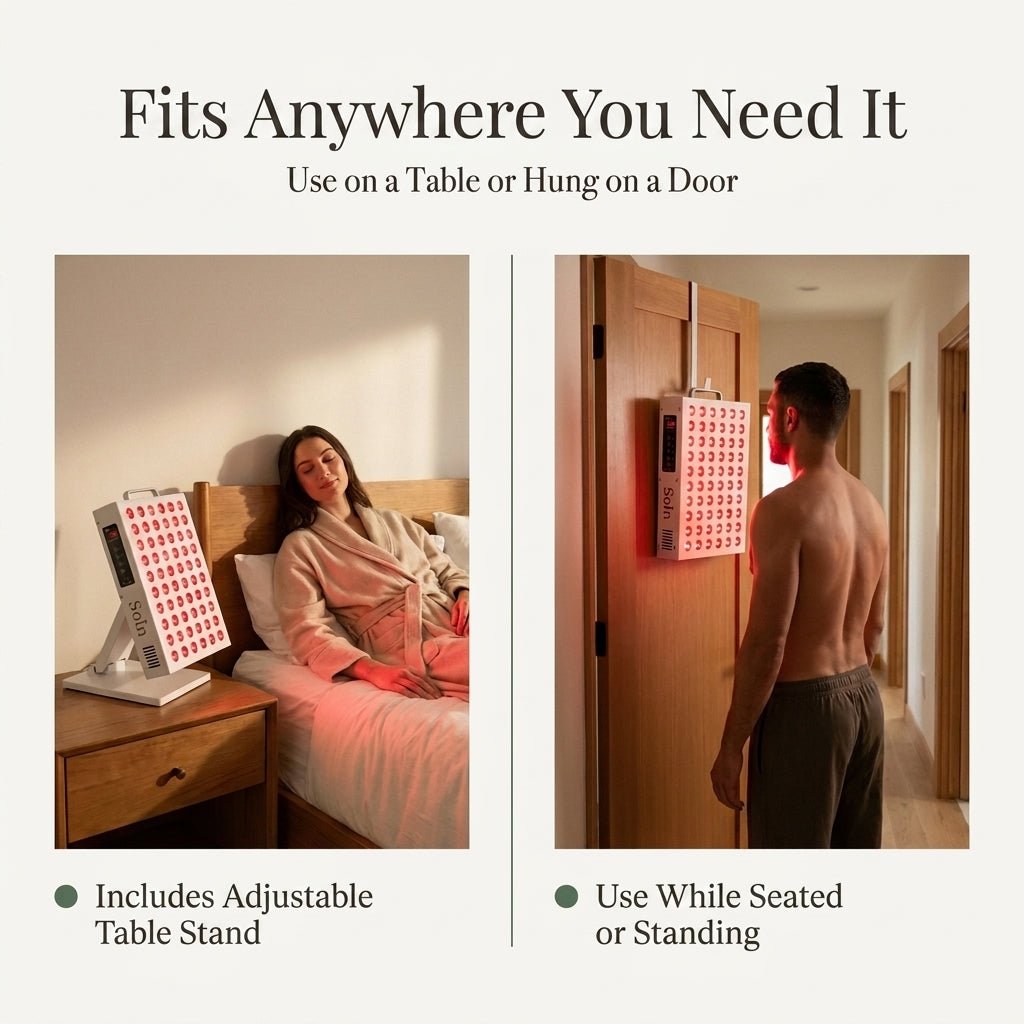
Tabletop, door, or wall
A kickstand for the counter, a hanging kit with snap links for a door or wall, and a door hook in the box. No drilling, and the panel sits where your routine already is, which is the whole point of keeping it up.
Specific goals. What to expect, week by week.
Specific conditions. Documented outcomes. Honest timelines.
Fine lines, dullness, and uneven tone
10 min daily · 12 in (30 cm) · red mode · face and neck
“My skin looks more rested. Three people in two weeks asked if I had had a facial.”
Visible improvement in skin texture typically reported from week 4. Collagen remodelling is cumulative. Results strengthen over 12 weeks with consistent use.
The desk worker’s persistent tension
10–20 min daily · 6 in (15 cm) · NIR + red · lower back
“The tension I carry across my lower back has been there so long I had stopped noticing it. After a few weeks I started noticing when it was absent.”
Meaningful reduction in stiffness reported by week 3–4 with consistent daily use.
Knee and joint stiffness
10–15 min daily · 6 in (15 cm) · NIR mode · target joint
“After six weeks of daily sessions, something had genuinely shifted. The stiffness that was just background noise for years. I started noticing when it was absent.”
Easing of tension typically felt within 2–3 weeks. Improvement accumulates over 8–12 weeks.
For the nights when the body is tired but the mind is not
10 min pre-bed · 12 in (30 cm) · NIR mode · chest and face
“This is the only thing that reliably makes me feel physically ready to rest. Not tired. Ready. It is a different feeling.”
Improvement in sleep onset reported within 1–2 weeks of consistent evening use.
Post-workout soreness and recovery
15–20 min post-training · 6 in (15 cm) · NIR + red · target muscle group
“I train five days a week. Next-day soreness dropped noticeably within two weeks. My recovery window is shorter.”
Reduction in DOMS typically reported within 2 weeks of consistent post-training use.
Hair thinning that started quietly
10–15 min daily · 6 in (15 cm) · NIR + red · scalp
“New growth near my temples within the first six weeks. I had been watching that area for two years. The change was real and visible.”
People focused on early thinning often describe positive changes over a couple of months. Results most pronounced in early-stage thinning.
Persistent redness and the flush that never fully calms
10 min daily · 12 in (30 cm) · red mode · face and cheeks
“My redness had been my defining feature for fifteen years. After six weeks I stopped covering my cheeks before leaving the house. That was the moment I believed it.”
People with easily-flushed skin often describe a calmer, more even look over a few weeks of daily use. Flush-prone skin improves gradually. Flush episodes become less frequent and less intense over 8–12 weeks.
Breakouts that keep coming back
10 min daily · 12 in (30 cm) · red mode · face, chin, and jaw
“I’m 34. I was promised this was over. My chin breaks out every cycle, my skin is dull by Thursday, and retinol makes me peel without fixing it. Four weeks in, the breakouts are half what they were.”
660nm red light supports the skin's natural recovery process. People using it on blemish-prone skin often describe calmer, clearer-looking skin over a few weeks.5
Plantar and achilles tension that kept coming back
15 min daily · 6 in (15 cm) · NIR + red · heel and achilles
“A year of trying different things. Six weeks of daily sessions and I walked to my car without thinking about my foot. That hadn’t happened in a long time.”
Near-infrared light supports the body's natural recovery process in tendon and connective tissue. Most users report meaningful easing of morning stiffness within 4–6 weeks of consistent daily use.6
The lower back tightness that sits there every single day
15–20 min daily · 6 in (15 cm) · NIR mode · lumbar area
“I stopped calling it pain because it had become too ordinary. The panel just sits on the counter behind me while I read. Three weeks in I realised I had stopped shifting position every twenty minutes. That was it.”
Persistent lower back tension typically eases within 3–4 weeks. Recovery is cumulative. Most users report a measurable reduction in daily discomfort by week 6–8.
The rotator cuff that never quite loosened up
15 min daily · 6 in (15 cm) · NIR mode · shoulder
“Eighteen months on I was still reaching for things at shoulder height with my left arm. I’d accepted it as my new baseline. After eight weeks of daily sessions I caught myself using it without thinking. Small thing. Massive difference.”
The shoulder and rotator cuff area typically responds to near-infrared light over 6–12 weeks of consistent use. Early easing of tension typically felt within 2–3 weeks. Range-of-motion improvements accumulate over weeks 6–12.
The stiffness that makes the first hour slow
10–15 min daily · 6 in (15 cm) · NIR mode · hands and fingers
“The first thing I did every morning was wait for my hands to work. Typing, opening jars, turning keys: all of it took longer than it should. Six weeks in I stopped mentally calculating how long each task would take.”
Used on stiff joints, people often describe easier movement in the morning over several weeks. It supports the body’s natural recovery. Daily use produces the most consistent results. Mobility improvements are gradual and accumulate. Most users notice the change only in retrospect.
Waking at 3am and lying there until 5
10 min pre-bed · 12 in (30 cm) · NIR mode · chest and shoulders
“My sleep was fine until it wasn’t. For two years I’d wake at 3am, mind immediately on. No reason. Just on. Ten minutes of the panel before bed and the 3am wake-up stopped. Not immediately. But it stopped.”
Near-infrared light supports the body's natural wind-down process before sleep. Most users report deeper, less-interrupted sleep within 1–2 weeks. Consistent evening use compounds over 4–6 weeks.
The body clock that lost track of when to rest
10 min at local bedtime · 12 in (30 cm) · NIR mode · face and chest
“I travel constantly for work. Shifting time zones every week had made my sleep genuinely unpredictable. Using the panel at whatever time I wanted to be my bedtime gave my body something consistent to anchor to.”
Near-infrared light supports the body's natural sleep-wake rhythm. Consistent use at the same time each evening helps re-anchor the sleep-wake cycle. Most frequent travellers and shift workers report meaningful improvement within 2–3 weeks.
After birth, easing back into your body.
10 min daily · 6 in (15 cm) · red + NIR · abdomen, lower back, or pelvic area
“Six weeks postpartum, everything hurt in ways I hadn’t anticipated. The panel was the one thing I did consistently because it required nothing from me except to sit there. Three months on, I feel rebuilt.”
Red and near-infrared light support the body's natural recovery process.7 Meaningful improvements in improvements in comfort and ease of movement typically reported from week 4–6. Consult your midwife or physician before starting postpartum use.
Still sore on Thursday from Monday’s session
15 min post-training · 6 in (15 cm) · NIR + red · target muscle group
“I’m 44. I train four days a week because not training makes everything worse. The recovery window that used to be 24 hours had become 72. Within three weeks of daily post-session use, it was back to 36. I can train consistently again without the arithmetic.”
Near-infrared light supports the body's natural post-exercise recovery process. Most users report reduced muscle soreness within 2 weeks. Recovery window shortens progressively over 4–8 weeks of consistent post-training use.
Hair shedding that kept going longer than expected
10 min daily · 6 in (15 cm) · NIR + red · scalp
“At four months postpartum the shedding was expected. At seven months it started to feel like something else. The gap near my temples was new. Eight weeks of daily scalp sessions and the gap has closed and the shed has slowed. I’m protective of this routine now.”
Red and near-infrared light support scalp circulation and the skin around the follicle. People focused on early thinning often describe positive changes over a couple of months. Results most pronounced in early-stage or hormonally driven thinning.
A tight, unhappy scalp that affects everything above the neck
10 min daily · 6 in (15 cm) · red + NIR · scalp and crown
“Persistent scalp tightness, flaking, hair that wouldn’t grow past a certain length. My derm said poor circulation. I started using the panel on my scalp because I had nothing to lose. The tightness has eased. The flaking has stopped. The texture is different, heavier, somehow.”
Poor scalp circulation and tension-related hair stagnation typically respond within 4–8 weeks of consistent daily use. Red light improves micro-circulation; near-infrared supports the body's recovery response in the deeper tissue layers. Density and texture improvements are gradual and cumulative.
Individual experiences. Results vary from person to person.
▸ View clinical references
SkinWunsch A, Matuschka K. A controlled trial to determine the efficacy of red and near-infrared light treatment in patient satisfaction, reduction of fine lines, wrinkles, skin roughness, and intradermal collagen density increase. Photomed Laser Surg. 2014;32(2):93–100.
Back and ShouldersChow RT, Johnson MI, Lopes-Martins RA, Bjordal JM. Efficacy of low-level laser therapy in the management of neck pain: a systematic review and meta-analysis of randomised placebo-controlled trials. Lancet. 2009;374(9705):1897–1908.
JointsBjordal JM, Coappé C, Chow RT, Tunér J, Ljunggren EA. A systematic review of low level laser therapy with location-specific doses for pain from chronic joint disorders. Aust J Physiother. 2003;49(2):107–116.
SleepZhao J, Tian Y, Nie J, Xu J, Liu D. Red light and the sleep quality and endurance performance of Chinese female basketball players. J Athl Train. 2012;47(6):673–678.
RecoveryLeal-Junior EC, Vanin AA, Miranda EF, de Carvalho PT, Dal Corso S, Bjordal JM. Effect of phototherapy on exercise performance and markers of exercise recovery: a systematic review with meta-analysis. Lasers Med Sci. 2015;30(4):925–939.
ScalpAvci P, Gupta GK, Clark J, Wikonkal N, Hamblin MR. Low-level laser (light) therapy (LLLT) for treatment of hair loss. Lasers Surg Med. 2014;46(2):144–151.
Skin / AcnePapageorgiou P, Katsambas A, Chu A. Phototherapy with blue (415 nm) and red (660 nm) light in the treatment of acne vulgaris. Br J Dermatol. 2000;142(5):973–978.
TendinopathyTumilty S, Munn J, McDonough S, Hurley DA, Basford JR, Baxter GD. Low level laser treatment of tendinopathy: a systematic review with meta-analysis. Photomed Laser Surg. 2010;28(1):3–16.
Tissue RepairAvci P, Gupta A, Sadasivam M, et al. Low-level laser (light) therapy (LLLT) in skin: stimulating, healing, restoring. Semin Cutan Med Surg. 2013;32(1):41–52.
Be honest with yourself about what you need. We will be too.
The most common reason people end up with the wrong device is buying for aspiration rather than reality.

Choose the Soln Compact Panel if…
- You want to treat one or two targeted areas per session: face, neck, lower back, knees, shoulders, or scalp.
- You live in an apartment, shared house, or anywhere a full-size panel would be spatially or socially out of the question.
- You want a device that lives on your counter, turns on in ten seconds, and gets used every morning.
- You travel. It fits in carry-on luggage.

Choose a full-body panel if…
- Full-body coverage in a single 10-minute session is genuinely non-negotiable and you have the floor space to use it daily.
- Your primary goal is systemic: circadian optimisation, full-body recovery protocols, not a named targeted concern.
- You have used a compact device consistently for 6+ months and have genuinely outgrown it.
| Consideration | Soln Compact Panel | LED Face Mask |
|---|---|---|
| Face & neck | ✔ | ✔ |
| Back, knees, shoulders | ✔ | ✘ |
| Near-infrared (deep tissue) | ✔ | ✘ most masks red-only |
| Whole household | ✔ | ✘ |
| Hands-free session | ✔ | ✔ |
| Travel-friendly | ✔ | varies |
| Irradiance at distance | Up to 212 mW/cm² at 3 in (8 cm) | Surface contact |
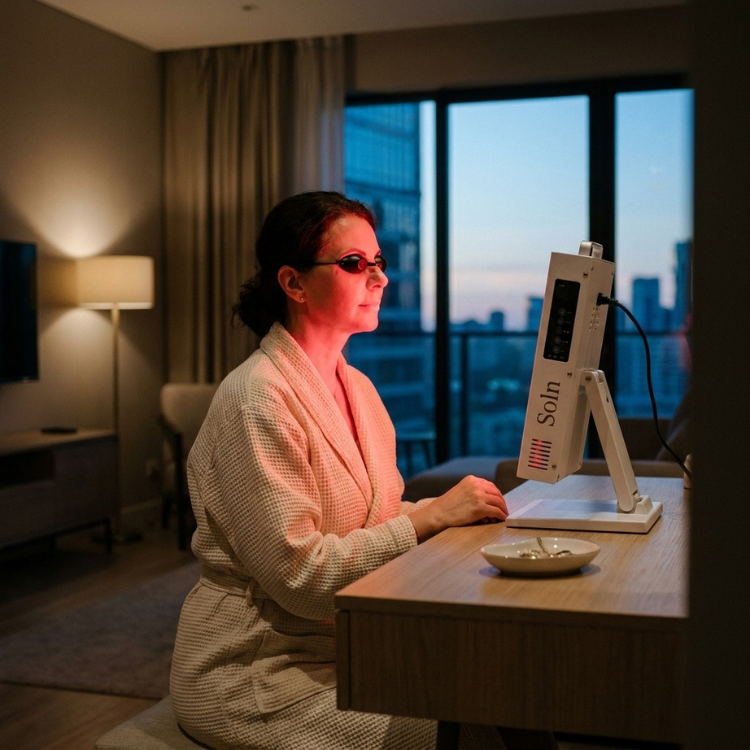
Warmth and relaxation
Most users notice warmth, relaxation, and often deeper sleep within the first few days. This is normal and expected. Cellular changes are accumulating beneath the surface. Do not measure results in week 1.
The critical week
Week 2 is when most people stop: before anything has had time to show. Nothing is wrong. Collagen remodelling and cellular recovery are cumulative processes. Do not measure results in week 2. Keep going.
First visible changes
Visible improvement in skin tone or a noticeable easing of tension or skin improvement typically reported from week 4 with consistent daily use. This is the checkpoint worth paying attention to.
Meaningful results
The timeline for meaningful results on the condition you are targeting. Skin texture, fine lines, persistent discomfort, sleep onset, joint stiffness: all require eight to twelve weeks of consistent daily use. Consistency is the variable that drives outcomes, not session length.
Frequent Questions
Does red light therapy actually work, or is this expensive pseudoscience?
The mechanism is documented. Photobiomodulation: the absorption of specific wavelengths of light by mitochondrial receptors, has a substantial peer-reviewed evidence base across dermatology, sports medicine, recovery science, and sleep research. The Soln Compact Panel uses 660nm red and 850nm near-infrared: the two wavelengths with the strongest and most replicated published evidence.
Results vary by individual, by condition, and by consistency of use. We do not make claims we cannot source. What we can tell you is that this is applied photobiology: not a recent trend.
Is near-infrared light safe to use on my face? What about my eyes?
Near-infrared light is invisible. This is exactly why protective goggles ship in the box: not as an accessory, not at additional cost.
For face use, we recommend red-only mode at 12 in (30 cm). The near-infrared wavelength in the Soln Compact Panel: 850nm: is distinct from the longer wavelengths (940nm, 1060nm) associated with concerns around facial fat loss and melasma.
If you have melasma, are pregnant, take photosensitising medications, or have had recent cosmetic procedures, consult your practitioner before starting use.
Is a compact panel powerful enough, or will I end up needing to upgrade?
The Soln Compact Panel delivers meaningful irradiance across the wavelengths used in red light research, with peak irradiance up to 212 mW/cm² at 3 in (8 cm): above the minimum threshold referenced in the photobiomodulation literature.
The honest answer on upgrading: if full-body coverage in a single session is your primary goal, a larger panel serves that better. If your goal is treating specific areas daily: face, neck, back, knees, shoulders: this panel delivers meaningful irradiance across the wavelengths used in red light research where it counts. A compact panel used every day consistently outperforms a large panel used twice a week. Consistency is what drives results.
What if it breaks and I can't get a response from support?
The most common reason people hesitate at this price point is exactly this. Broken units and silent support teams have defined this category. It is a legitimate concern.
The Soln Compact Panel carries a 2-year warranty. If it fails within that period, email us at studio@discoversoln.com: we respond throughout the day, every day. Tell us what happened. We will sort it.
How do I use it correctly, and will I actually keep using it?
Distance: 6 in (15 cm) for body areas. 12 in (30 cm) for face and neck.
Time: 10–20 minutes per area. More time does not mean more results.
Frequency: 5–7 sessions per week. Consistency determines outcomes.
Mode: Red only for skin. Near-infrared or combined for deep tissue, joints, and sleep.
Week by week:
Week 1: warmth, relaxation, often deeper sleep within the first few days.
Week 4: visible changes in skin tone or a noticeable easing of tension or skin improvement.
Week 8–12: meaningful results for the condition you are targeting.
Week 2 is when most people stop: before anything has had time to show. Do not measure results in week 2.